
Thursday, December 8, 2016


Sunday, June 28, 2015
The Story of Jerry and Jane or is coaching useful?

The new trend of seeking out a coach smacks
of the 1980’s obsession, where everybody had to have a “mind” therapist of some
sort. Was this trend useful or merely self-indulgent? Certainly the older
generation were non-plussed. “Just get
over it!” Was a common and less than useful rejoinder! The world has not
obviously become a better place because of the vogue, but many people have
become a lot more self-aware and overcome a host of emotional barriers as a
result, and that cannot be a bad thing!
OK, what’s the point of coaching? In order
to answer the question, we need to look at what I would like to describe as the
five-point coaching matrix.
The coach’s first job is to help his client
clarify exactly what he is setting out to achieve. Most people will be able to
tell you what they don’t want but are usually stumped when asked what exactly
it is they do want! The coach helps her client get a clear picture of the
desired objective. This clarity is amazingly important. Let’s give an example,
and let’s invent an imaginary client whom we shall call Jane. Jane is a
successful is corporate career girl. She is approaching 40, but has not found
the man of her dreams. The clock is ticking and she is in a bit of a hurry. Her
coach, Jerry, knows this, so he helps Jane clarify what sort of man would be
her “ideal” partner. What would he look like? How would he dress? What would he
do? How would he behave? What would his interests be and so on? Jerry helps
Jane bring her “honey” to life. She can now see him, hear him and feel him so
he becomes a real person for her. This is the blueprint for what she is looking
for.
The second step is for the team to sit down
and construct a road map of how to bring somebody like “honey” into Jane’s
life. This is the action plan. Unfortunately, ideal life partners are not
delivered to the front door, or at least not usually. You must go out there and
do something about it.
The third phase is for Jerry to help Jane
uncover some skill she may lack that are standing in the way of her reaching
her desired outcome. Maybe she needs to know about internet dating, or if this is
a business niche then she might need to hone up on marketing or computer
skills. The coach points out the area that is in need of up-skilling and then helps
provide training where the missing ingredients can be found.
The fourth step the team need to
investigate is the environment. If Jerry is a health coach and Jane’s goal is
weight loss, then they probably need to take stock of Jane’s kitchen cupboards.
What foods does she have that are standing in her way of losing those excess
pounds? Jerry will counsel Jane to get the offenders out of her environment and
probably to remind her that food does not have legs and she needs to be a lot
more careful in her shopping habits.
Fifth and lastly, we turn to mind matters.
Jerry uses a plethora of tools to help Jane identify and then overcome the
trapped emotions and fears, doubts, limiting beliefs, insecurities, self image
issues and a myriad of other chunks that are preventing her from reaching her
goal. If all of these didn’t exist she would have got there already, wouldn’t
she? Any challenge anybody faces lies somewhere in this matrix. Repair the
matrix and all the Janes of this world have a good chance of making their
dreams come true!
To answer the original question, is all of
this worthwhile? I certainly think so, don’t you? If you would like to find out
for yourself, click here and you can sign up for a cost free 45 minute phone or Skype strategy session.
As they say the proof of the pudding is in the eating.
Alister Bredee
Koh Samui
June 28th 2015
Sunday, June 21, 2015
Is Coaching Worth the Money?
 We hear a
lot these days about the benefits of coaching, but is it genuinely worthwhile? The
stars of the industry include Joe Vitale who appeared in Rhonda Byrne’s breakthrough
film, “The Secret”. Joe charges $10,000 for a dinner meeting. Coaching “hunk”
Christian Micklesen expects you to pay $250,000 for a year’s work together and
there is a guy in Arizona who charges a whopping $1,000,000. These sound like
incredible sums of money; the whole issue poses the question is it worth it?
We hear a
lot these days about the benefits of coaching, but is it genuinely worthwhile? The
stars of the industry include Joe Vitale who appeared in Rhonda Byrne’s breakthrough
film, “The Secret”. Joe charges $10,000 for a dinner meeting. Coaching “hunk”
Christian Micklesen expects you to pay $250,000 for a year’s work together and
there is a guy in Arizona who charges a whopping $1,000,000. These sound like
incredible sums of money; the whole issue poses the question is it worth it?
The answer
must be “yes”, otherwise people would not pay! Those who sign up for these
programs know at gut level it is really up to them, but they need help in
achieving the goals they desire. You, really can’t do it on your own, an
objective mentor is somebody you are accountable to, who challenges your ideas
and motivates you to get the best out of yourself. So when you sign-up with a
life, business, relationship, money, sex or whatever you like coach you expect
a bang for your buck! Most, if not all, coaches have coaches themselves and if
results were not forthcoming the word would surely get out! On a personal note,
I signed up with a coach last September for a year’s business and mojo
enhancement at $500.00 per month. I never believed I could keep up the payments
but have found that has not been an issue, in fact I have increased my earnings
fivefold and have learned a huge amount along the way. When our contract ends
in August, I will then seek out somebody else to continue the journey.
Why is this
so successful? Coaching is not therapy, although you might expect to undergo
some therapy whilst coaching. In a therapeutic situation, you go and see the
therapist on a session by session basis. Thus, when you feel you are mended you
quit the therapy. For instance I would only go to see my massage therapist when
I had a problem. As an example; you have a frozen shoulder, you go to see your
“body worker” who works on the shoulder; the pain vanishes and ease begins to
return, so you think you’re done and you quit the sessions! But have you truly
got to the root cause of what put the shoulder out of kilter in the first
place? Probably not, the cause could be a misaligned vertebra which has not
even been considered at that short term juncture. Result the shoulder is likely
to seize up again at some time in the future.
A “Health
Coach” working on the frozen shoulder example, does not contract to work with
the client from session to session but instead on a time basis. The client has
a goal of repairing the shoulder and the coach designs a road map that takes
the client to the desired destination. This is likely to be a long-term
relationship in which the shoulder is fixed and remains symptom free for an
appreciable period. This treatment might involve a lot more than simply
manipulating the locked limb.
The
agreement could span one, three, six or even twelve months. The parties contract
to meet-up two or three times per month. Payment is made on a monthly basis or
is often a discounted lump sum for the whole training at the outset. The coach
and the client commit to the process whereby the latter not only shows up for
the sessions but usually has exercises and tasks to complete in between. A
committed relationship to change like this, usually gives a more spectacular
result than the “fix-it and see" approach generated by the single session
model.
Many coaches
offer cost free strategy sessions as a first off in the process. The intention
is to discern whether the coach can actually help the client with his/her problem
and to see if they can comfortably work together over the long term. Some of
these sessions are face-to-face, but more frequently they are via telephone or
Skype. If you would like to try one, see what's on offer here.
Alister
Bredee
Koh Samui
Thailand
June 21st
2015
Sunday, May 18, 2014
“.What do you Remember when you Forget to Remember?”

I am
embarrassed to admit I was a little reluctant to begin reading John Flaherty’s
new book, ."Addiction Unplugged"” Yes, he generously provided me with a copy,
and I knew I could not, not read it!
I was expecting another quasi-academic treatise into
the therapy and practice of addiction treatment and to be quite honest due to
recent experience, I had had my fill of those. How wrong can you be?
Instead, by reading"Addiction Unplugged" I have
undergone an amazing, experiential journey into change. My change…..the book
brings the reader face to face with critical life issues and then provides
solutions to overcome the challenges. It does that by means of hypnotic languaging patterns and some other powerful
tools taken from NLP as well as the remarkable power of Hawaiian, Ho’pono’
pono. This roughly translates to “make it right”. John uses the Hawaiian
technique as a hugely potent re-framing tool which makes the book itself
a near miraculous healing strategy. He does this by inviting the reader to
examine distressing events of the past. This
is not an invitation to wallow in the painful emotions that surface. Instead,
we acknowledge the uncomfortable trigger
with a simple “thank-you”. This stills the turmoil and brings peace to the
event. The occurrence is no longer a drama and we do not need to spend hours
processing the feelings that bubble to the surface. What happened, happened.!
It was part of the developmental journey
we call life. We are now ready for the next step, which is acceptance and the
learning that goes with it. “I am sorry, please forgive me.” We are really
detaching from all blame and judgement. We dealt with the events as best we
could. We had no resources to behave differently, but now we do, “thank you”.
Personally, I found this to be hugely powerful when it came to reviewing
certain happenings in my own life, not least of all was my own “rehab” journey.
In 2011 I was invited to join a new rehabilitation project that was being launched in a breathtaking location on the tropical island of Koh Samui I was asked to join the team, not as an addiction counselor , which I am not,but as a meridian energy technique specialist to
aid the treatment process as it helped the clients to make their way back to
sobriety. I can only say how disappointed I was to witness the dysfunction
inherent in the “Center” itself which was sadly also reflected in the amount of
relapse experienced when people returned
to the environment they called home.
During my stay there, I witnessed and participated in a drama fully worthy of
Greek tragedy . I was present and witnessed the public sacking of the clinical
director during a staff meeting that had been stage managed for that very
purpose. I felt like Judas when the new director came over and hugged me after
the meeting in an effort to elicit my unwilling support.
Events quickly unraveled. The new director was
deeply committed to a 12 step approach and my fate was quickly sealed when I
made an impassioned plea that it was essential the residents came to recognize their power and not their frailty. I wish I had this book then, because I could have waved it in the faces of those
who sought to control by fear and instead demonstrate that to heal those who craved
to break free from addiction, could do
so from a place where they could see
that they were never separated from the source of their own power which would unfailingly provide them with the strength to
find their own healing. This message comes over strongly, well done John for
bringing it for all of us to see!
"Addiction Unplugged" is an essential read for everybody addict or non-addict, therapist or
non-therapist. I urge you all to beg, borrow or steal a copy and let it assist
you on your own journey, because by doing this You cannot Not create a better experience of life, you know!
Alister Bredee D.HH, DCN MD (Alternativa Medicina)
Koh Samui,
Thailand.
May 18th 2014
Friday, May 2, 2014
Our New Mission Statement.

"Using Leading edge quantum technology, Health Ambit Consultancy, diagnoses your sub-optimal health issues and then comes up with an easy to follow road map that brings you back into balance."
Sunday, April 27, 2014
Balancing the Brain.
Are the two hemispheres of your brain balanced? Generally this is not the case. People seem to be either left brain or right brain dominant. See the diagram below.... it's wonderful to be analytical but wouldn't it be even more wonderful if you were both analytical and creative at the same time? If you are predominantly left brain you are using only 50% of your full potential. This is like going into the boxing ring with one arm tied behind your back. Contact us if you would like to learn how to balance the hemispheres. Remember, even Picasso had to book!balance his cheque book
In general the left and right hemispheres of your brain process information in different ways. We tend to process information using our dominant side. However, the learning and thinking process is enhanced when both side of the brain participate in a balanced manner. This means strengthening your less dominant hemisphere of the brain. Listed below are information processing styles that are characteristically used by your right or left brain hemisphere.
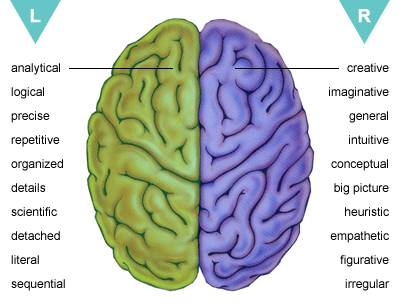
The left side of the brain processes information in a linear manner. It processes from part to whole. It takes pieces, lines them up, and arranges them in a logical order; then it draws conclusions. The right brain however, processes from whole to parts, holistically. It starts with the answer. It sees the big picture first, not the details. If you are right-brained, you may have difficulty following a lecture unless you are given the big picture first.
Right Brain Inventory
|
Left Brain Inventory
|
•Visual, focusing on images, patterns
|
•Verbal, focusing on words, symbols, numbers
|
•Intuitive, led by feelings
|
•Analytical, led by logic
|
•Process ideas simultaneously
|
•Process ideas sequentially, step by step
|
•'Mind photos' used to remember things, writing things down or illustrating them helps you remember
|
•Words used to remember things, remember names rather than faces
|
•Make lateral connections from information
|
•Make logical deductions from information
|
•See the whole first, then the details
|
•Work up to the whole step by step, focusing on details, information organized
|
•Organization ends to be lacking
|
•Highly organized
|
•Free association
|
•Like making lists and planning
|
•Like to know why you're doing something or why rules exist (reasons)
|
•Likely to follow rules without questioning them
|
•No sense of time
|
•Good at keeping track of time
|
•May have trouble with spelling and finding words to express yourself
|
•Spelling and mathematical formula easily memorized
|
•Enjoy touching and feeling actual objects (sensory input)
|
•Enjoy observing
|
•Trouble prioritizing, so often late, impulsive
|
•Plan ahead
|
•Unlikely to read instruction manual before trying
|
•Likely read an instruction manual before trying
|
•Listen to how something is being said
|
•Listen to what is being said
|
•Talk with your hands
|
•Rarely use gestures when talking
|
•Likely to think you're naturally creative, but need to apply yourself to develop your potential
|
•Likely to believe you're not creative, need to be willing to try and take risks to develop your potential
|
You have a left hand, but you barely use it. Why?
Do you like being one-sided and handicapped? Two dominant hands are better than one! Learn how to unleash both sides of your brain and body. |
Tuesday, January 14, 2014

Parasites

It is important to grasp that people who are infected by parasites are influenced at more than the physical level. The parasites themselves are attracted to the individual through his/her thought processes. These processes block development on all levels, which means physically, emotionally, mentally and spiritually. Parasites crave what they need and send subliminal messages to the host demanding certain foods be included in the diet. They also communicate feelings to us, which again are to insure their own survival. When they die off they send “death signals” to the body, which feels very depleted and sometimes believes he/she is also dying.
Feelings and emotions such as “I must allow others to take advantage of me” (a passive attitude) and “I will allow people to suck me dry”, are strong magnets to worms, flukes and other parasites. People with parasites usually have weak boundaries and find it difficult to say “no”. In all cases they .have self-esteem issues.
In order to get rid of parasites it often necessary to free ourselves of certain people who drain us. As we accomplish this work, we strengthen sufficiently to dispel many of the internal micro-parasites that plague us.
It’s hard to believe but limiting beliefs create an acid inner environment. Parasites adore an acidic environment. Once we start shedding old and limiting programming we begin to feel hugely better, but more remarkably the Ph begins to rise as we become more alkaline. These pests find alkalinity an unwelcome environment and start to leave of their own accord.
If you notice somebody grinding his teeth (bruxism), you have a clear signal indicating the presence of parasites. This alerts you to the need of a cleanse. Firstly, start with a belief clean up. Health Ambit Consultancy can definitely help you with this and then embark on a physical cleanse. All meat and vegetables have parasites. It is very important everything is washed very thoroughly before cooking . Regardless of what you eat, the more balanced you belief system the fewer “bugs” will be present.
The body needs to be slightly alkaline , sitting in the range of between 7.35 and 7.4 Ph. Once there it will better resist worms, flukes and candida. A herbal clean-out is the best way to go. This should ideally be completed in the spring, between the new moon and the full moon (a two week period). It is in this time that hidden vermin comes out to breed. It is relatively easy to kill adults but the eggs are the problem, so you will have to repeat the process several times before you can be assured of having reached your parasite free-state. Before embarking on the cleanse it is important you seek the guidance and advice of a health-care professional.
To complete the process you will need.
Walnut-wormwood extract. This must not be used by people with diabetes.
Ionized copper. An excellent cleanse that helps rid the body of tapeworms.
Cayenne Pepper.
Oregano Oil ( Take it internally in a gel cap)
Ginger.
Garlic
Olive leaf extract. This kills yeast/candida, too.
Clove oil/ picture. This kills the eggs.
Thyme. It kills the parasites in drinking water.
Charcoal. Clears giardia and related pests.
Fresh juice: 2 carrots,1 stick of celery. Half beetroot, a clove of garlic and a pinch of ginger. Keeps you alkaline and clean,too.
Good luck and if we can be of any health, do not hesitate in getting in touch. We are here to help.
Friday, August 9, 2013
How Genes and Epigenetics Influence Your Behavior GeniusAwakening.com
How Genes and Epigenetics Influence Your Behavior

“It is all in the genes!”
A very common and clichéd statement we have heard a bit too often! Be it [from] the medical community trying to ascertain the cause of mystifying disease or your doctor trying to warn you of an impending illness citing the example of your elders.
So, what is the jargon all about? That our genes and heredity influences how we look, we already know, but do they also have any bearing on how we behave? More importantly, do our genes also influence our sense of consciousness and self-awareness? In other words, it might be an interesting revelation to look into how far our genetic mapping is responsible for the kind of people we become.
In fact, there is sufficient research to indicate that more than 50 percent of the differences in the level of extroversion in people can be attributed to genetic differences. Meanwhile, the rest - 40 to 50 percent of difference is owing to the environmental factors, which we can also label as the mechanics of epigenetics[1].
Read on as we talk about your genetic mapping and how it influences the kind if individual you develop into. We will also shed some light on the science of epigenetics and how it influences the way we evolve over the years.
Key terms to know:
When it comes to the study of how your individual personality traits develop, there are generally two aspects to the debate, including genetic factors and epigenetics. Let us study each one before going any further.
Your Genes – This is precisely the “Nature” part of your personality. You are born with a certain set of genes and that defines the traits you get as a part of your heredity.
Epigenetics – This is the “Nurture” part of your personality. Referred to as the second level of genetics, this science explains how your genetic structure continuously changes and evolves owing to the influence of your environment and lifestyle. [The epigenome is actually a chemical that turns on and off our genes.]
Now that we have explained the concepts, let us move on to understand how YOU can influence your genes for a better personality and a happier [and healthier] life.
5 steps to influence your genes:
With some learning, consistent effort and a strong will power, you can modify your environment as well as your lifestyle to bring out your best. In other words, you can choose how the mechanism of epigenetics influences your original genetic structure.
Read on to know more about the five important ways in which you can influence the effect your environment will have on your genes.
1. Eat healthy and right
What we eat and drink has a direct impact on our genetic make-up. When we eat the right type of nutrients in an optimum quality, over the years our body system develops the proper balance. On the contrary, unhealthy eating habits alter your body’s mechanism and metabolism. Eventually, such traits are passed on to the next generations in the line of heredity.
2. Exercise well
Another dictate of healthy living, it keeps your body in the right shape. Maintained over long periods, it then has an effect on your overall stamina and fitness levels, which is then passed on to the next generations.
3. Live in a healthy environment
Even if you maintain a healthy lifestyle, an adverse environment can have a different impact on you. The best example to demonstrate this effect is that of passive smoking. Do whatever it takes to ensure that your surroundings are equally healthy and clean. This way, you will be able to avoid any negative influence that otherwise might be transferred down the heredity line.
4. Be under good influence
Make sure that you surround yourself with people of good mettle. Keep company with learned and aware people who will have a positive influence on you. The effect of negative company eventually seeps in and affects the kind of person you become.
5. Be in touch with your inner consciousness
Listen to your heart, mind and body. Learn to be at peace with yourself and your surroundings. Keep a sense of what your body finds repulsive and make efforts to change the same for your betterment.
Such modifications and efforts made in the right direction go a long way in shaping the influence on your genes. Apart from helping you to pass on a healthy life to your progeny, it will also help you to live a fuller, healthier and a more successful life.
—————–
[1] Source – http://www.redstonereview.com/2013/06/genes-human-behavior-and-personality-differences/
Posted byHealth Ambit Consultancy
Sunday, June 23, 2013
Dramatic Rise in Dengue Fever, worldwide!

Figures emerging from
the Thai Ministry of Public Health indicate that the number of instances of Dengue
fever in the country has tripled since the beginning of the year .According to
the “Nation” newspaper there are 49,000 reported cases with 59 deaths as of
June 21st 2013. The highest mortality rate appears to be among
young people.
Dengue is transmitted
by the bite of an infected Aedes aegypti mosquito. The black and white spotted
insect is usually busy during the day; the mosquitoes pick up the so called
virus from infected persons and pass it on to others when they bite.
Symptoms of Dengue are
high fever, usually over 40 C, headaches extreme weakness severe muscle and joint pain; it’s not called
“breakbone” fever for nothing!, In some cases a rash appears. As the disease progresses, platelet
counts begin to drop (thrombocytopenia). Platelets are tiny cells that
circulate in the blood; their function is to enhance the clotting process.
Without adequate platelets, hemorrhages can occur and these are life
threatening. A normal platelet count
ranges between 150 and 400 million per milliliter of blood. The danger
of Dengue fever is that the platelet count can drop significantly below 100
million with the ensuing risk of life threatening internal bleeding. If this
were to happen the condition becomes re-classified as HDF or Hemaroghic Dengue
Fever, a condition that is always a medical emergency
If you display any of the
symptoms, go at once to the hospital and get checked out. Pharmaceutical based
western medicine has no specific treatment for the disease. If the platelet
count is too low, you will be hospitalized. If not you will be sent home with a
supply of “Acetaminophen”. This is paracetamol, which has many trade names
including Tylenol, Anacin or Panadol. In Thailand one variant is Paracap, and
another is Sara. This is an analgesic designed to reduce the body temperature,
or fever. The doctors will also advise drinking lots of water to prevent
dehydration. Drinking electrolyte salts is also useful as is bed rest. Avoid aspirin,
Ibuprofen and Naproxen, because these can thin the blood and trigger hemorrhage.
American homeopath
William Boericke mentions Dengue Fever on page 924 of his “Materia Medica” that
appeared in 1927. Surely it is a mistake to call this a new phenomenon? He
tested 12 homeopathic remedies that helped symptoms disappear. For those who
don’t know homeopathy is based on the belief that the body understands how to
heal itself. A further assumption is “like cures like”; meaning if a substance
causes a symptom in a healthy person; giving a miniscule amount to a sick
individual promotes healing. Incidentally, this was the preferred medical
treatment until the mid-nineteenth century when western based pharmaceutical
medication moved to the fore. Homeopathy still has a huge following all over
the world and its successes can be testified by millions. Advocates of
homeopathic treatment include the British Royal Family., David Beckham and
Jennifer Anniston.
There have been
several studies using homeopathy in the treatment of Dengue fever, particularly
in South America. The results have been very favorable. The Thai Health
Ministry has approved one of the
remedies recommended by Boericke; that is Eupatorium Perfollatum 200 c.
This also goes under
the name of “boneset”. This is derived from a plant, native to North America
but known as Feverwort elsewhere. It
seems native North Americans have used the herb in the treatment of Dengue and
malaria for hundreds of years .Further evidence attesting to the long history
of the illness. The homeopathic remedy contains the tiniest trace of the original
plant. This can also be used as a preventative; the recommended dose is two pills
twice per week with water. Again the results have been encouraging. However,
there are another 11 remedies in Boericke’s list: these include Aconite,
Gelsenium, Arsenicum Album and Belladonna. It would always be best to consult a
professional to advise you on the remedy best suited for you and your
individual list of symptoms.
Using the juice from
papaya leaves has shown to help elevate a declining platelet count. It is quite
difficult to juice these large leaves; so many people feeling unwell choose instead
to use fresh apple juice, with the juice of half a lemon included. Packaged and
other synthetic variants bought from a grocery shop will simply not do! It has to come from the fruit itself and
preferably drunk soon after juicing. Ideally three of four apples yield
sufficient liquid to make the drink.
If you are unfortunate
enough to come down with Dengue, the Health Ambit Consultancy is only too happy
to provide you with advice and help at no cost. Please phone 084 7814718, contact via
website http://www.healthambit.com or message via Facebook.
Alister Bredee
Subscribe to:
Posts (Atom)